
Sliding windows
Sliding screens suit sliding windows. Ensure full travel and sealed edges; incomplete closure creates an entry gap.
SK Fung installs insect screens: concealed, roller, pleated, sliding, fixed and removable frames. We also provide window safety mesh, child-safety and cat screens, and repair torn mesh or loose frames.
Free on-site measurement, design and quotations. Call 3709 2164 or WhatsApp 6686 7879 to enquire.
Registered Minor Works Contractor MWC(W) 42/2014, with window inspection qualifications. We plan screens to preserve emergency access and future inspection of window hardware, avoiding unnecessary removal later.
Service Overview
Free site measurement, design and quotations. Call or WhatsApp for enquiries.
Screens reduce insects while windows remain open. We match fixed, sliding or removable systems to windows, doors and suitable glass-house openings, with cleaning access.
Denser is not always better. Standard 18×16 mesh, around 1.1 × 1.3 mm openings, generally blocks mosquitoes, flies and moths. Finer mesh restricts airflow. Persistent insects often enter through gaps, not the mesh itself; see diagnosis below.
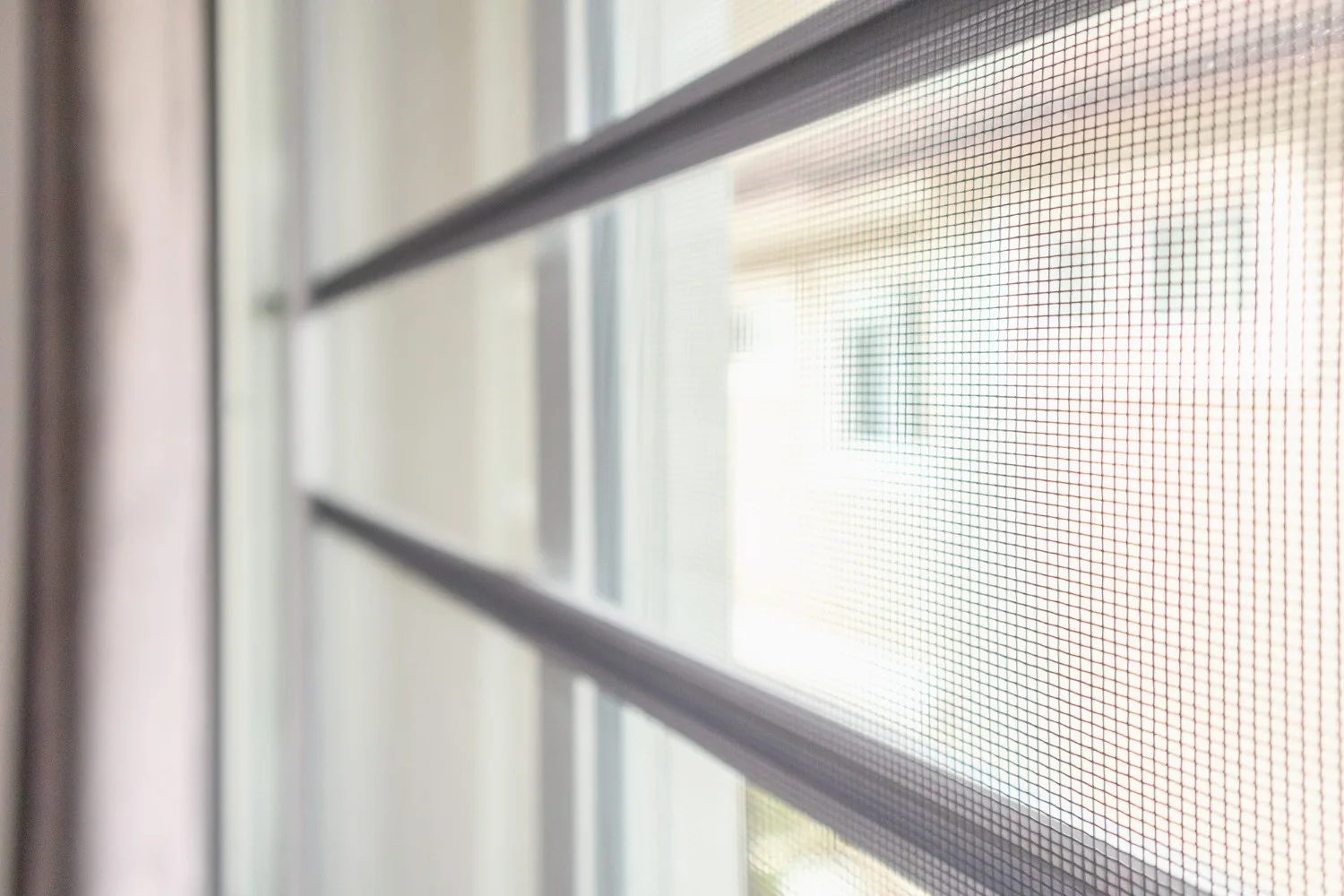
Choosing a style
| Style | Storage / opening | Applications and trade-offs |
|---|---|---|
| Concealed screens | Retractable mesh in slim frames. | Discreet when stored; more delicate mechanisms may need specialist servicing. |
| Roller screens | Retract vertically or horizontally into a cassette. | Convenient operation and cleaning; more visible, robust frames. |
| Pleated screens | Fold to one side. | Large windows and sliding doors; clean guides regularly to prevent sticking. |
| Sliding screens | Move sideways parallel to window sashes. | Simple and durable for sliding windows; ensure complete closure. |
| Fixed / removable frames | Fixed sheets or removable panels. | Economical with good airflow and removable cleaning options; cannot retract when unused. |
Plan screen tracks during window replacement for accurate alignment, sealing and shared measurement.
Specification data
Mesh numbers describe openings per inch in each direction: 18×16 means 18 horizontally and 16 vertically.
| Mesh | Approximate aperture | Protection | Open area / airflow |
|---|---|---|---|
| 16×16 | Around 1 mm. | Mosquitoes, flies and common insects. | Higher open area and good airflow. |
| 18×16 residential standard | Around 1.1 × 1.3 mm. | Mosquitoes, flies, wasps and moths. | Fibreglass around 59–60%. |
| 20×20 fine mesh | Smaller openings. | Also smaller fruit flies, midges and drain flies. | Around 50%. |
| Pet-resistant mesh | Thicker strands. | Insect protection with increased scratch resistance. | Around 45%. |
| Solar screens | Densest mesh. | Insect protection and shading. | Can be below 25%. |
Use 18×16 for typical homes; consider 20×20 for actual small-insect problems near drains, vegetation or markets, accepting reduced airflow.
A typical fibreglass screen has 18×16 mesh, approximately 0.28 mm strands, 60% open area, 1.2 × 1.4 mm apertures and 119 g/m² weight. Brands vary; choose for airflow, durability and visibility.
Materials
| Material | Properties | Suitable use |
|---|---|---|
| Fibreglass | Flexible, good airflow and views, lower cost. | Typical homes; prolonged UV exposure can embrittle it. |
| Polyester | Good toughness with comparable or slightly higher open area. | Locations needing tear resistance without metal mesh. |
| 304 stainless steel | Strong, scratch-resistant and durable. | General environments and pet or impact exposure. |
| 316 stainless steel | Improved corrosion resistance. | Coastal, humid or salty locations. |
| Pet-resistant mesh | Thick strands resist scratching and impact. | Pet homes; around 45% open area and lower airflow. |
Choose corrosion-resistant, compatible frames and screws in coastal homes, just as with stainless window hinges.
Window compatibility
Sliding screens suit sliding windows. Ensure full travel and sealed edges; incomplete closure creates an entry gap.
Top-hung windows generally take internal fixed or removable screens, preserving handle and stay access and sash clearance.
Casement windows take internal roller or fixed screens; avoid covering handles and locks.
Pleated or large sliding screens suit frequent use. Clean guides and avoid trip hazards at bottom tracks.
Removable screens ease grease and moisture cleaning. Avoid excessively fine mesh that clogs and restricts airflow.
Screens can protect opening lights, but slightly reduce cooling airflow. Account for this in glass house design.
Safety mesh
Its purpose, material and anchoring differ from insect mesh; they cannot substitute for each other.
| Item | Insect Screens | Window safety mesh: child / cat screens |
|---|---|---|
| Main purpose | Keep insects out. | Reduce falls of children, pets or objects. |
| Mesh | Lightweight for light and ventilation. | Heavier strands with greater strength. |
| Fixings | Frames with retaining splines, often removable. | More substantial anchors into sound substrates. |
| Interchangeability | No. Insect mesh cannot withstand safety-screen impact loads. | |
DMC and management rules may restrict external components, colours and styles. Internal screens generally raise fewer concerns; seek consent for facade anchoring or prominent external installations before proceeding.
Problem diagnosis
Find gaps first; denser mesh cannot repair an open joint.
Warped frames may require replacement rather than new mesh alone. Combine repairs with aged window seals or hardware where windows also leak or fail to close.
Our process
Cleaning and care
Combine checks of windows, barriers and shower seals.
Service coverage
Our office is at Room F11, 10/F, How Ming Factory Building, 99 How Ming Street, Kwun Tong, Hong Kong. We serve Hong Kong Island, Kowloon and the New Territories.
Frequently Asked Questions
30 questions on styles, mesh, materials, safety, diagnosis, quotations and care.
Concealed, roller, pleated, sliding and fixed / removable frames. Choose for window type, operation and cleaning.
Openings per inch: 18×16 has 18 horizontally and 16 vertically. Higher numbers mean finer apertures and less airflow.
Typical 18×16 screens generally suffice. Persistent entry usually indicates tears or gaps rather than insufficient density.
Consider 20×20 mesh, accepting around 50% open area compared with about 59–60% for standard fibreglass mesh and reduced ventilation.
Screens reduce airflow. Indicative open areas are 59–60% for standard fibreglass, 50% for fine mesh, 45% for pet mesh and potentially below 25% for solar screens. Keep mesh clean and consider existing ventilation.
Fibreglass is flexible, economical and clear. Stainless steel is stronger and scratch-resistant. 304 suits general use; 316 offers greater coastal corrosion resistance.
Use pet-resistant or stainless mesh with reinforced frames for scratching. Fall protection requires dedicated cat safety screens with appropriate anchors, not ordinary insect mesh.
Insect screens prioritize airflow and insect exclusion; safety mesh uses heavier material and stronger anchors to reduce falls. Both may be fitted, but are not interchangeable.
Preserve window and emergency operation, inspection access and secure corrosion-resistant anchors. Adult supervision and keeping climbable furniture away remain essential.
All windows must be inspected personally by a QP. Screens obstructing hinges and hardware may need removal. Choose removable systems or access openings.
Check tears, splines, warped frames, poor perimeter contact, incomplete closure, air-conditioner gaps and drains before changing mesh density.
Yes. Dry traps, poor pipe joints or vent gaps may admit insects. Check these if window screens are sound.
Fixed and removable frames are simpler. Roller, concealed and pleated mechanisms need care and may require a technician. Inspect frame alignment and hardware too.
Both retract. Concealed designs use slimmer, less visible frames; standard rollers are generally more robust and easier to service.
Large windows, terrace and sliding doors. Clean guides and folds to prevent sticking.
Sliding screens are natural matches; fixed panels can protect the commonly opened side. Verify complete closure and sealing.
Use internal fixed, removable or roller screens, preserving sash clearance and handle operation.
Yes, on opening lights. Account for reduced airflow and increase openings or extraction if needed.
Slightly. Fine mesh and thick strands reduce visibility. Thin dark strands often provide clearer outward views than light mesh.
Common mesh colours include grey, black and white; frames may match silver, white, champagne or dark brown windows. Actual options depend on product.
Rinse removable panels with mild detergent. Vacuum and gently wipe fixed screens. Avoid force and high-pressure water; clean quarterly or more often in dirty environments.
Material, UV exposure and use determine life. Fibreglass may become brittle; coastal metal needs corrosion checks. Inspect annually.
Yes if frames and spline channels remain sound. Warped, corroded or broken frames may require replacement to eliminate gaps.
Plan tracks and alignment together for better sealing, appearance and shared visits. Coordinate mandatory inspection repairs too.
Yes, through DMC or management appearance rules. Check consent before external fixings or prominent installations.
Light mesh is usually removable, but fixed metal or heavy safety systems can impede rescue or escape. Preserve operation and avoid permanently blocking all openings.
Window count and size, style, material, mesh, frame colour, hardware, removal, repairs and access determine cost. Free measurement and quotations are available.
Usually more, due to heavier materials and stronger anchoring. Quotes specify openings, strands, fixings, hardware and inspection implications.
Measure and confirm first, then fabricate and fit. Smaller installations may finish in one fitting day; combined window work follows the overall programme.
SK Fung holds MWC(W) 42/2014, inspection qualifications and CIC-certified technicians. Browse screen photographs and related window, glass-house and partition projects.
Related pages
Explore custom insect and safety screens, mesh and ventilation, materials, window compatibility, pet protection, secure fixing, gap diagnosis, repairs and care across Hong Kong.
